A Clear Example of Game-Changing the Agenda:
“Powering Europe & Electro Valley”
Doubling the share of electricity in the EU’s primary energy supply from roughly 20% to 40% in just 10–15 years is an immense undertaking. It essentially requires a “war-time” industrial mobilization.
To reach 40% of primary energy, the EU must not only double its generation but also electrify sectors currently dominated by fossil fuels (like heavy industry and heating) while simultaneously expanding the grid to carry that load.
1. The Budget: Trillions, Not Billions
Current estimates from the European Commission and financial institutions like Goldman Sachs suggest a total investment of €2 trillion to €3.5 trillion over the next decade.
- Power Generation: Roughly €1.0–€1.4 trillion is needed for new capacity (primarily wind and solar).
- Power Grids: Approximately €600 billion to €800 billion is needed by 2030, rising to €1.4 trillion by 2040. This includes:
- Distribution Grids: ~€730 billion (local lines for EVs and heat pumps).
- Transmission & Interconnectors: ~€470 billion (long-distance “super-highways” and cross-border cables).
- Annual Spend: The EU needs to jump from its current ~€400 billion annual climate investment to at least €800 billion per year.
2. New Manufacturing Capabilities
To avoid replacing “Russian gas dependence” with “Chinese technology dependence,” the EU would need to massively scale domestic production:
| Sector | Current State | Required Shift |
| Wind Turbines | Strong domestic base, but struggling with margins. | Scale up to produce 30 GW+ per year (up from ~16 GW). Needs massive new casting and blade factories. |
| Solar PV | >90% dependent on Chinese imports. | Re-establishing a “Solar Silicon Valley” in Europe to produce 30 GW of modules annually by 2030. |
| Transformers | 2-3 year lead times for high-voltage units. | Doubling or tripling factory output for large power transformers and switchgear. |
| Cables | High demand for subsea (offshore) and HVDC. | Significant new specialized extrusion plants for high-voltage direct current (HVDC) cables. |
3. Installation & Infrastructure Requirements
The physical “boots on the ground” and hardware requirements are staggering:
- Grid Mileage: Installation of over 100,000 km of new or refurbished transmission lines and millions of kilometers of distribution lines.
- Interconnectors: Doubling cross-border exchange capacity to roughly 165–180 GW by 2030 to allow Spain’s sun or Denmark’s wind to power Germany’s factories.
- Workforce: A “job gap” of approximately 1.5 million skilled workers (electricians, grid engineers, and installers) must be filled.
- Permitting Reform: Currently, a new transmission line can take 10 years to permit. This would need to be slashed to 2–3 years through emergency “Overriding Public Interest” legislation.
The Reality Check
The 20% to 40% jump is technically possible but faces a “Permitting & Pylons” bottleneck. While we have the technology to generate the power, the grid is currently the weakest link. Without a 100% increase in grid investment compared to the last decade, new wind and solar farms will simply sit idle, waiting for a connection.
ElectroValley
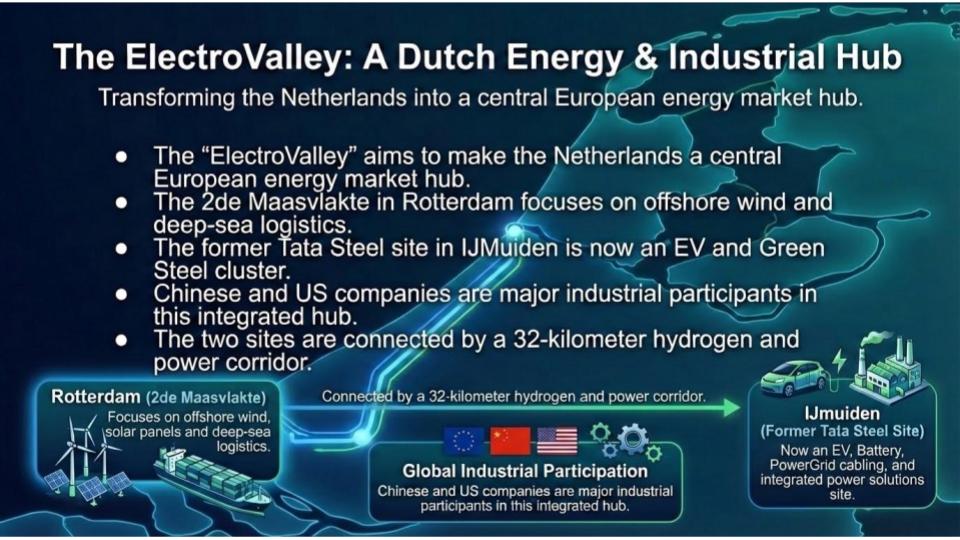
According to the envisioned Powering Europe the development of a high-capacity “ElectroValley” would transform the Netherlands into a central hub for the European energy market.
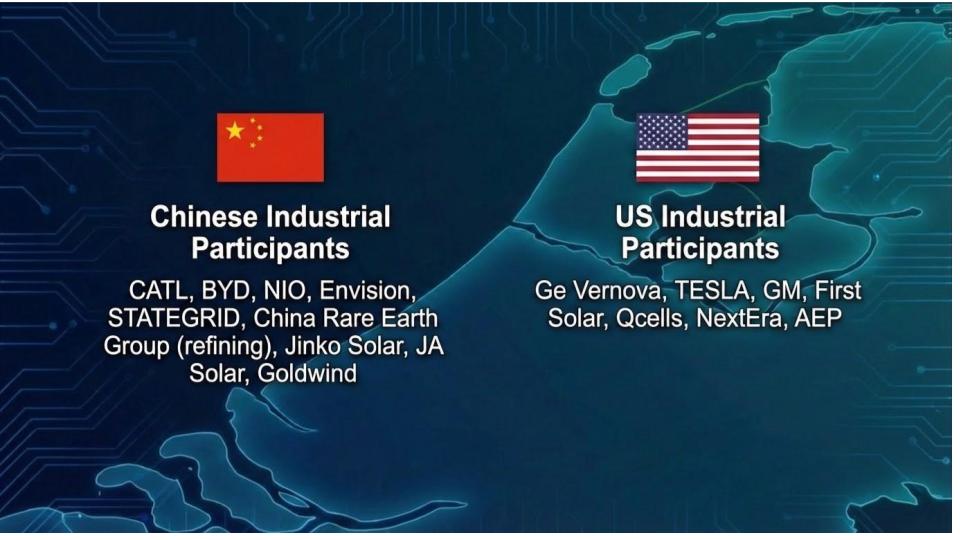
Below is a situational map and breakdown of how these major industrial players would be distributed between the 2de Maasvlakte (Rotterdam) and the former Tata Steel site (IJmuiden).
Location 1: 2de Maasvlakte, Rotterdam (The Maritime Energy Hub)
This 2,000-hectare reclaimed site is the primary gateway for deep-sea logistics and offshore wind integration.
- Manufacturing & Refining Base (China):
- State Grid: Development of the primary high-voltage DC (HVDC) converter stations to manage power from North Sea wind farms.
- China Rare Earth Group: Specialized refining facility located near deep-water quays for the processing of imported ores into magnets for EV motors and turbines.
- Goldwind: Assembly plant for ultra-large offshore wind turbines, leveraging the 20-meter deep docks for immediate deployment.
- Jinko Solar & JA Solar: High-volume automated assembly lines for solar modules to be distributed via the European rail network.
- Manufacturing & Infrastructure (US):
- GE Vernova: Major hub for “Grid Brain” technologies, including offshore wind sub-stations and grid-stabilizing software.
- First Solar & Qcells: Advanced R&D and manufacturing centers for high-efficiency solar cells, integrated with Rotterdam’s chemical cluster for raw material supply.
- NextEra Energy & AEP: Operational headquarters for the European “Energy Peace Board” grid management, overseeing the stability of the high-capacity corridor.
Location 2: Former Tata Steel Site, IJmuiden (The Green Steel & EV Cluster)
This 750-hectare site is repurposed from traditional blast furnaces to “Direct Reduced Iron” (DRI) and high-tech manufacturing.
- EV & Battery Ecosystem (China):
- CATL & BYD: Large-scale “Giga-factories” for battery cells, utilizing the site’s existing 100km railway network for supply to European auto-makers.
- NIO: European logistics and “Battery as a Service” (BaaS) center, managing the regional swap-station network.
- Envision: Integrated “Smart Energy” campus focusing on battery storage and AI-driven energy management for the IJmuiden cluster.
- EV & Mobility Ecosystem (US):
- Tesla: Expansion of European manufacturing focusing on energy storage (Megapacks) and heavy-duty electric transport (Semi).
- GM: Advanced electric powertrain and vehicle assembly plant, utilizing the site’s specialized steel for chassis production.
The “ElectroValley” Energy Corridor
The two sites are connected by a 32-kilometer hydrogen and power backbone. This corridor serves as the “theater of construction”, replacing former industrial decay with a seamless loop of production and distribution.
- Benefit to Scale: By 2030, this integrated Dutch-US-Chinese hub is projected to manage 7.4 GW of landing offshore wind power and serve as the primary source for the “Huge European Market”.
Dutch Siting Complex (Example Only)
A New Economic Engine
In the context of the Powering Europe, the Dutch “ElectroValley” is projected to be a massive economic engine. By 2026, the Netherlands has already seen wind and solar generation surpass all fossil sources for the first time, setting a high bar for this new industrial corridor.
Below is the detailed breakdown of the GWh capacity and workforce requirements for the sites at 2de Maasvlakte and former Tata Steel (IJmuiden).
1. Estimated Energy & Battery Output (GWh)
The combined output from the Chinese and US “Giga-factories” in ElectroValley is designed to meet a significant portion of the European market’s projected 1,500 GWh long-term demand.
- CATL & BYD (IJmuiden Cluster): * CATL currently maintains a 45.2% global market share, with a single month’s global installation reaching 32.5 GWh in early 2026.
- BYD follows with a 13.8% share. In ElectroValley, their combined localized output is expected to contribute to the European goal of reaching up to 470 GWh of nominal capacity in the short-to-medium term.
- Tesla (IJmuiden Cluster): * Tesla’s global energy storage deployments reached a record 14.7 GWh in a single quarter by 2026.
- The ElectroValley site would leverage Tesla’s new Megablock technology (integrating four Megapack 3 units), which has a global production target of 133 GWh per year.
- Solar Manufacturing (Maasvlakte): * Jinko Solar & First Solar would feed into a Dutch market that is already expanding rapidly, with solar growth hitting +31% year-over-year by 2026.
- A typical industrial-scale solar battery plant in this region is designed for 1–5 GWh of annual capacity per unit to maintain operational flexibility.
2. Workforce Requirements
The transition from heavy “dirty” industry to ElectroValley creates a massive shift in the labor market, requiring a mix of high-tech manufacturing and specialized engineering roles.
- Direct Job Creation:
- For battery cell production, it is estimated that 50 to 100 direct jobs are created for every 1 GWh of capacity.
- A 40 GWh cluster (similar to Tesla or CATL scales) would therefore require a direct workforce of 2,000 to 4,000 employees per site.
- Solar & Wind Manufacturing:
- Solar PV remains the global leader in renewable employment, with China alone employing 4.2 million people in the sector as of 2026.
- The Maasvlakte wind assembly (Goldwind/GE Vernova) would draw from a global wind workforce that has grown to 1.9 million.
- Infrastructure & Construction:
- The 32-kilometer hydrogen pipeline connecting the two sites is already nearing completion as of March 2026, requiring specialized “Energy Transition” contractors and engineers.
- Grid Congestion Relief: The Dutch government is prioritizing a “Crisis Law” to accelerate the training of grid-specialized workers to manage the 52.61 GW of renewable capacity expected by the end of 2026.
3. Strategic Benefit to Scale
By clustering these firms, the Netherlands achieves economies of scale that reduce the investment cost of battery production, currently estimated between €75 million and €120 million per GWh in Europe.
| Cluster | Primary Output | Key Resource Link |
| Maasvlakte 2 | Offshore Wind & Rare Earths | Direct access to 20-meter deep sea docks. |
| IJmuiden | EV Batteries & Green Steel | Access to 100km of internal heavy-rail. |
| Hynetwork | Green Hydrogen | 32km pipeline serving the 20 largest industrial users. |
ElectroValley: Investment and Lead Time
To establish the “ElectroValley” as a premier global hub, the capital investment (CAPEX) must account for the high costs of European construction, high-tech machinery, and the unique maritime and rail integration at 2de Maasvlakte and IJmuiden.
By 2026, market data indicates that while technology costs have declined, the sheer scale of the “Energy Peace” vision requires a massive front-loaded investment.
1. Estimated Program Capital Investment (CAPEX)
Total estimated investment for the two primary clusters is projected between €25 Billion and €35 Billion, excluding long-term R&D.
| Industry Component | Est. Cost per Unit / GW | Total Cluster CAPEX |
| Battery Giga-factories (CATL, BYD, Tesla) | €75M – €110M per GWh | €12B – €18B (Based on ~150 GWh initial phase) |
| Solar Manufacturing (Jinko, First Solar, Qcells) | €150M – €250M per 5GW plant | €1.5B – €2.5B (Multiple 5GW-10GW lines) |
| Offshore Wind Assembly (Goldwind, GE Vernova) | €700M+ per facility | €2B – €3B (Including specialized docks/vessels) |
| Rare Earth Refinery (China Rare Earth Group) | €450M – €800M | €0.8B – €1.2B (High-spec environmental processing) |
| Grid & Pipeline Infra (State Grid, AEP, Hynetwork) | €4B – €7B | €5B – €8B (HVDC substations + 32km H2 backbone) |
- Note on Battery Costs: EU cell production remains significantly more expensive than in China (approx. €90-110/kWh vs €45-60/kWh), driven by higher energy and labor costs.
2. Project Lead Times & Throughput Milestones
Large-scale “Energy Peace” projects in Europe typically face a 4 to 5-year window from groundbreaking to full-scale operations.
A. Phase 1: Construction & Integration (Years 1–2)
- Grid & Hydrogen Backbone: The 32km hydrogen pipeline and Maasvlakte HVDC landing points are the “hard dependencies”. These must be operational by early 2027 to support high-power manufacturing.
- Foundation & Shells: Specialized maritime construction at Maasvlakte 2 requires roughly 18–24 months before heavy machinery (like WTIVs) can be housed.
B. Phase 2: Pilot Production (Years 3–4)
- First Battery String: Initial “Pilot” throughput from CATL/Tesla is realistic by late 2028, with an initial ramp-up to 20% capacity.
- Solar Assembly: Solar module assembly (Jinko/JA Solar) has a shorter lead time; first Dutch-made panels could roll out by mid-2027 if modules are initially assembled from imported cells.
C. Phase 3: High Capacity Throughput (Year 5+)
- Full Operations: Target date of 2030–2031 for the entire ElectroValley to hit “High Capacity” (e.g., 470 GWh battery goal).
- Offshore Integration: Full-scale turbine deployment from Goldwind/Mingyang is expected to align with the commissioning of the IJmuiden Ver wind farm (2 GW) in 2029.
3. Critical Success Factors
- Grid Congestion: The project requires a “Crisis Law” to bypass the 8–10 year wait typical for Dutch grid reinforcements.
- Supply Chain Buffer: A minimum cash buffer of roughly €570 million is recommended for pre-revenue operational expenses, such as specialized engineering wages.
Phasing and Governance
To achieve high-capacity throughput for the ElectroValley initiative, a coordinated multi-billion euro investment and a phased development timeline are required. Based on 2026 industrial data and European infrastructure benchmarks, the following estimates outline the program’s capital requirements and lead times.
1. Estimated Program Capital Investment (CAPEX)
The total investment to site these manufacturing capabilities across the two clusters is estimated between €25 billion and €35 billion. This does not include long-term R&D or operational subsidies.
| Industry Component | Est. Cost per Unit / GW | Total Cluster CAPEX |
| Battery Giga-factories (CATL, BYD, Tesla) | €75M – €110M per GWh | €12B – €18B (Phase 1: ~150 GWh) |
| Solar Manufacturing (Jinko, First Solar, Qcells) | €150M – €250M per 5GW | €1.5B – €2.5B (Targeting 10-20GW) |
| Offshore Wind Assembly (Goldwind, GE Vernova) | €700M+ per facility | €2B – €3B (Docks & heavy-lift infra) |
| Rare Earth Refining (China Rare Earth Group) | €450M – €800M | €0.8B – €1.2B (High-spec processing) |
| Grid & H2 Infrastructure (State Grid, AEP) | €5B – €8B | €5B – €8B (HVDC & H2 backbone) |
- Cost Drivers: Battery manufacturing in Europe remains significantly higher than in China, with costs ranging from €90–110/kWh in the EU compared to €45–60/kWh in China.
- Infrastructure Support: The Dutch government has already released nearly €1 billion from the Climate Fund to support the construction of new wind farms and associated landing infrastructure.
2. Project Master Schedule (Gantt Summary)
The project follows a 4 to 5-year lead time from Final Investment Decision (FID) to realistic high-capacity throughput.
Phase 1: Foundation & Infrastructure (2026 – Early 2027)
- Grid Interconnection: Establishing HVDC landing points at Maasvlakte is the critical path; this must be operational by early 2027 to power industrial-scale equipment.
- Permitting & Site Prep: Leveraging the Dutch Energy Act (effective Jan 1, 2026) to fast-track “Energy Hub” designations and grid-ready site permitting.
Phase 2: Pilot Production & Tooling (2027 – 2028)
- Solar Assembly: First Dutch-assembled modules from Jinko/JA Solar are realistic by mid-2027, initially using imported cells while domestic cell lines are tuned.
- Battery Pilot Lines: CATL and Tesla begin pilot production with an initial ramp-up to approximately 20% of nameplate capacity by late 2028.
Phase 3: High-Capacity Throughput (2029 – 2030)
- Full Commercial Scale: The clusters reach high-capacity throughput by 2030, aligning with the Dutch national goal of 21.5 GW of offshore wind capacity.
- Offshore Wind Delivery: Goldwind and GE Vernova reach full assembly throughput in time for the 2029/2030 installation windows for major North Sea zones like IJmuiden Ver.
3. Critical Constraints to Lead Time
- Grid Congestion: Without immediate execution of the “Crisis Law” for grid prioritization, lead times for high-power battery factories could slip by 2–3 years.
- Supply Chain Bottlenecks: A potential shortage of Wind Turbine Installation Vessels (WTIVs) towards the end of the decade could delay the “throughput” of wind components to the actual sea-beds.
II. Year-One Key Performance Indicators (KPIs)
| Metric | Target (Year 1) | Strategic Impact |
| Grid Integration | 15–20 GW Managed | Integration of North Sea wind via State Grid and GE Vernova systems. |
| Storage Capacity | 85+ GWh Produced | Combined output from CATL, BYD, and Tesla for the EU EV/Grid markets. |
| Economic Yield | €12B+ Direct Investment | Capital inflow from the “Global Energy Peace” private sectors. |
| Job Creation | 15,000+ Direct Roles | High-skilled manufacturing and engineering jobs at Maasvlakte and IJmuiden. |
III. Strategic ROI Breakdown
- Geopolitical Stability (“Energy Peace”): By placing the U.S., China, and the European state shareholders on a single ” Board,” the project creates mutual economic dependencies that disincentivize conflict.
- Logistics & Supply Chain Resilience:
- 2de Maasvlakte: Immediate deployment of Goldwind and GE Vernova offshore turbines via 20-meter deep docks, reducing transport costs by an estimated 15%.
- IJmuiden: The former Tata Steel rail infrastructure allows for “zero-mile” logistics between battery production (CATL/Tesla) and European auto-manufacturing hubs.
- Technological Supremacy: The “ElectroValley Accord” ensures the U.S. and Netherlands lead the transition to the next century’s energy economy, moving from “scarcity” to “abundance” through shared American and Chinese technical standards.
IV. Immediate Board Action Items
- Ratify the “Electro Valley Accord”: Formalize the invitation for China Power Engineering Companies to begin site preparation.
- Standardize the High-Capacity Corridor: Align AEP and State Grid on HVDC protocols for the cross-border European grid.
- Appoint the Oversight Committee: Confirm the participation of the relevant state stakeholder representatives to provide long-term institutional stability.